A dragging brake caliper does not always announce itself with a loud grinding noise or a warning light. Sometimes the first thing you notice is that the car feels a little heavier than normal, does not coast as far, or pulls slightly after you release the brake pedal.
The problem is that one brake is staying partially applied when it should have released. We see this fairly regularly, especially on vehicles with corrosion around the caliper hardware or brakes that haven't been taken apart and closely inspected in a long time.
Clues That One Brake Is Staying Applied
A dragging caliper creates friction even when your foot is off the brake. Depending on how badly it is sticking, the symptoms can be subtle at first or strong enough that you know something is wrong within a few miles.
Some of the clues we listen for are:
- The car pulls slightly while driving
- One wheel has much more brake dust than the others
- You smell something hot near one corner of the vehicle
- Fuel economy drops for no obvious reason
- The car does not coast as freely as before
- One wheel feels much hotter after a normal drive
- The brake pedal or steering wheel begins to feel different
Those signs do not prove the caliper itself has failed. A restricted brake hose, stuck parking brake mechanism, seized slide pin, or damaged hardware can hold the brake on in almost the same way.
Heat Is One of the Biggest Giveaways
When a brake stays applied, the pad keeps rubbing against the rotor. That friction creates heat. On a badly dragging brake, the wheel can become extremely hot even after a drive that did not involve much braking.
At our shop, comparing brake temperatures can tell us quite a bit. If three wheels are at a normal temperature and one is far hotter, we know that corner deserves attention. We do not recommend touching the wheel or brake parts yourself after driving because a severely dragging brake can get hot enough to cause a burn.
Why Brake Calipers Start Dragging
The caliper piston has to move outward when you brake and release enough afterward for the pads to stop clamping the rotor. Corrosion, damaged seals, contaminated brake fluid, or wear inside the caliper can prevent that piston from returning correctly.
The caliper itself is not always the problem. Slide pins can rust or lose lubrication, causing only one pad to stay pressed against the rotor. A brake hose can also deteriorate internally and trap hydraulic pressure at the caliper. From the outside, that hose might look completely normal. We have to test whether pressure releases before blaming the caliper.
How We Find Out What Is Actually Sticking
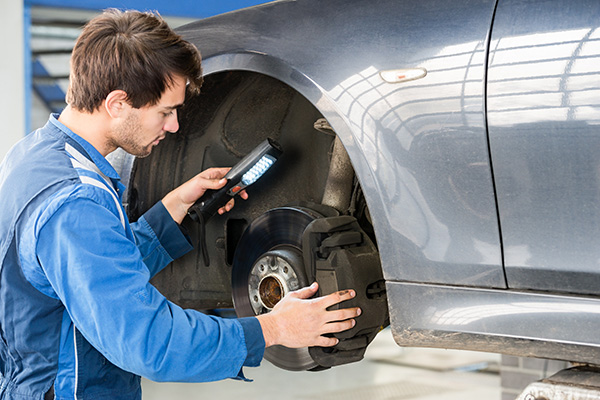
A good inspection starts with the symptom, not with replacing the first part that looks suspicious. We look at pad wear, rotor condition, caliper movement, hose condition, hardware, and temperature differences between wheels.
One thing we may check is whether the wheel turns more freely after opening the bleeder screw. If releasing hydraulic pressure frees the brake, the problem may be farther upstream, such as a restricted hose. If the brake stays stuck, the caliper piston, slides, or hardware move higher on the list. We also compare inner and outer pad wear because an uneven pattern can show which part hasn't been moving correctly.
The Repair Depends on What We Find
A seized caliper generally needs replacement, but the surrounding parts also need to be evaluated. If the rotor has been badly overheated or the pads have worn unevenly, installing a caliper alone leaves damaged brake parts in service.
A typical repair may involve:
- Replacing the failed caliper
- Servicing or replacing seized slide pins and hardware
- Replacing a restricted brake hose
- Installing new brake pads when wear is uneven or excessive
- Replacing or resurfacing damaged rotors when appropriate
- Bleeding the hydraulic system with the correct brake fluid
We also compare the brakes on the opposite side of the axle. Brake repairs need to leave both sides working consistently, not one side fresh and the other barely hanging on.
Do Not Keep Driving on a Brake That Is Getting Hotter
A mild drag can become a much bigger problem if the brake keeps overheating. Excess heat can damage the pads, rotor, wheel bearing, seals, and brake fluid. In severe cases, the vehicle may pull hard, or the affected brake can lose performance after overheating.
Regular maintenance helps because caliper slides, brake wear, fluid condition, and corrosion can be spotted before the wheel starts getting hot. If the car feels resistant, pulls, smells hot, or one wheel keeps collecting far more brake dust than the others, have the brake system checked before assuming it just needs pads.
Get Brake Caliper Repair In McFarland, WI, With Tom's Auto Center
If one brake is staying hot, dragging, pulling the vehicle, or wearing its pads faster than the others, Tom's Auto Center in McFarland, WI, can inspect the caliper, hose, slides, rotor, and hydraulic system to find what is holding the brake on.
Schedule a visit so we can repair the cause before excess heat damages more of the braking system.